
The Data Gap Nobody Talks About
Think about how a restaurant group runs its business. Labor schedules are built on traffic data. Food orders are driven by sales history. Every purchasing decision, every staffing call, every vendor contract has data behind it. Operators who don’t run this way don’t stay operators for long.
Now, think about how those same businesses manage their facilities.
For most multi-location operators, the facilities side of the business is running blind. There are no dashboards, no benchmarks, no performance scores. There’s just the phone call that tells you something went wrong. A restaurant manager reports the dining room is 85 degrees. A technician was dispatched at 11 PM because a walk-in stopped holding temperature. An emergency repair invoice that lands on the P&L without warning.
This is a data and analytics gap, and it’s a significant one. Facilities represent a meaningful share of operational cost, and yet most operators have no structured way to understand how those systems are performing, which locations need attention, or where maintenance spend is about to spike. The only signal is the emergency.
That’s the problem Act Hub was built to solve. With Act Hub 2.0, we’ve taken a major step forward in making that solution accessible to everyone who needs it, without requiring technical expertise to unlock its value.
Why Most Monitoring Tools Miss the Point
The market isn’t short on monitoring tools. Every building controls vendor, every sensor manufacturer, every IoT startup offers a dashboard. The facilities technology space is full of platforms that will alert you when something goes wrong, but what most of them can’t do is tell you what it means, how serious it is, whether it requires action today or can wait until next week, or what the right response actually is.
The result is alert fatigue. Teams stop trusting the signals, start ignoring the noise, and default back to waiting for the phone call anyway. What operators need is a platform that does the interpretation for them, one that surfaces what requires attention right now, explains why it matters, and makes the next step clear without requiring anyone to decode raw data or navigate a technically dense interface. That’s what Act Hub 2.0 is built to deliver.
What Act Hub 2.0 Actually Does
The core of Act Hub 2.0 is a front-end experience built around one principle: make facility intelligence accessible to anyone responsible for a location, regardless of their technical background.
The experience starts at the portfolio level. Every location is visible, color-coded by performance status. You’re looking at your entire portfolio and immediately seeing where things stand, without scrolling through data tables or waiting on a report.
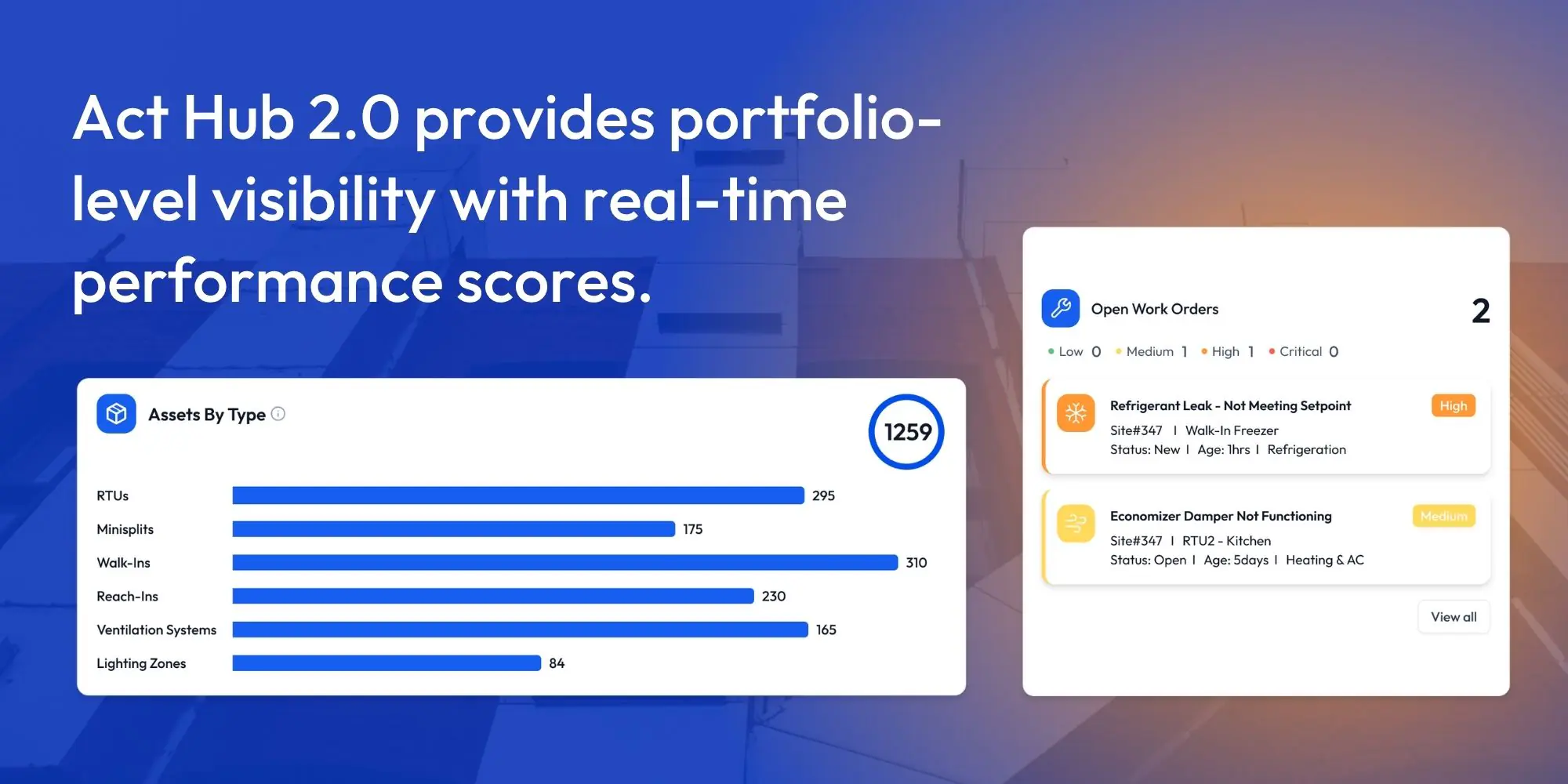
From there, the drill-down is intuitive. Click into a location, see the equipment. Click into a piece of equipment, see the specific issue paired with live data and automated work order context that tells you what’s happening and what needs to happen next. The platform does the interpretation, so the person using it can focus on the action.
And because Act Hub 2.0 is built mobile-first, this intelligence is accessible anywhere. Consider what that means across a typical operations team:
- Operations and facilities leaders get a current, accurate, portfolio-level view organized around what needs attention rather than what’s running fine.
- Maintenance technicians can access live work order data and real-time system readings while on the roof, without climbing down to check inside.
- Area managers whose office is their vehicle can see which of their locations needs attention before the call comes in.
Recently, while demonstrating the platform to an investor at an industry forum, the reaction after a brief walkthrough was immediate: “This is easy enough that I could do this.” He wasn’t a facility manager, and he wasn’t technically hands-on with these systems. But the experience was clear enough that the value was visible in minutes. That’s the standard Act Hub 2.0 is designed to meet.
What Predictive Operations Actually Looks Like
The clearest way to explain what this platform changes is to describe what a customer’s experience looked like before and after.
A few years ago, the Actuate team began working with a multi-location restaurant group that had recently acquired several new facilities. What they inherited, along with the buildings, was a backlog of deferred maintenance and equipment that hadn’t been well cared for. The first summer was exactly what you’d expect: equipment failures at peak volume, high-priority emergency calls, technicians scrambling, and real disruption to operations and staff.
The following summer was different. As the season approached and the heat arrived, the Actuate team noticed something: they hadn’t heard from this account the way they used to. The calls weren’t coming in. The escalations had quieted.
They’d made it through summer without a crisis, not because the facilities had transformed overnight, but because the team now had visibility into what was happening before it became a problem. Equipment issues were caught early. Repairs were scheduled before the heat arrived. The season came and went without the chaos that had defined the year before.
That’s what predictive operations looks like from the outside: a quieter summer, because the work had been done ahead of time. Act Hub 2.0 is built to make that transition faster and more accessible for every person in the organization who plays a role in keeping those facilities running.
Management by Exception: A Different Way of Operating
The operational philosophy behind Act Hub 2.0 is management by exception. Stable systems stay in the background. Issues that require attention rise to the top, clearly and immediately, so teams can act with confidence rather than sift through noise to figure out what actually matters.
This is especially important because facilities management in multi-location commercial operations is rarely one person’s job. Responsibilities are distributed across the organization, and information needs differ depending on your role. Act Hub 2.0 is designed to meet all of those needs without requiring everyone to learn the same technical vocabulary or navigate the same complex workflows.
And it doesn’t require adding headcount, expanding a facilities team, or investing in enterprise-grade building automation infrastructure. Act Hub 2.0 makes the teams already in place more capable and gives the people already managing facilities the intelligence they need to do it with greater confidence and less friction.
What’s Inside the Platform
Act Hub is built around four modular Action Hubs, each handling a different piece of the operations puzzle. Together, they give operators something most multi-location organizations have never had: a complete, current picture of portfolio performance with clear guidance on what to do about it.
- Facility Hub: Portfolio-level visibility with real-time performance scores, equipment KPIs, and management-by-exception views. The platform surfaces what needs attention, so teams aren’t scrolling through dozens of locations searching for problems.
- Maintenance Hub: Predictive alerts and diagnostics that provide root-cause context before dispatch. The right technician shows up with the right parts and the right understanding of what’s happening, which means fewer second trips, fewer surprises, and faster repairs.
- Energy Hub: Tracks how energy consumption shifts across the portfolio using digital energy twins, continuous models of how each system should be performing. Energy drift is often the first sign something is going wrong, long before a comfort complaint or equipment failure makes it obvious.
- Asset Hub: Condition and capital visibility across every location. Tracks equipment age, performance history, and condition so operators can identify which units are nearing end-of-life, which have declining performance trends, and where capital dollars should be prioritized. Repair-versus-replace decisions move from gut feel to a data-driven process.
The platform is modular and scalable. Operators can start with monitoring and expand into diagnostics, control, and deeper optimization over time as their needs evolve.
The Road Ahead
Act Hub 2.0 is a platform, not a product release. This launch is the beginning of a longer evolution, one that continues to deepen the intelligence available to operators, expand the range of systems covered, and increase the ease with which distributed teams can take action on what matters.
The goal has always been the same: give multi-location operators the tools they need to run their facilities the way they run every other part of their business, with data, with clarity, and with confidence. Act Hub 2.0 moves that vision from aspiration to reality.
If you’re ready to see what predictive operations looks like for your portfolio, the Actuate team would like to show you. Book a demo with the Actuate team.