
Ask a multi-location restaurant operator to name their biggest controllable cost, and they’ll say food and labor. Ask what’s quietly draining margin with no one managing it, and most won’t have an answer. That’s the gap Actuate exists to close.
Labor got scheduling and forecasting years ago. Inventory and food orders got predictive systems. Guest experience got speed-of-service metrics. Facilities, the equipment that keeps every restaurant and cafe running, never got the same treatment, because the data to manage it never existed. It’s the last unmanaged function in the business, and at today’s margins, it’s the clearest place left to protect profit.
Trouble Announces Itself at the Table, Not in a Report
The first sign of a failing system isn’t a maintenance alert. It’s a warm walk-in or a hot dining room. By the time the GM calls it in, the repair is already an emergency.
That pattern repeats across five problems every restaurant group knows by feel, even if no one has put a number on them:
- Equipment fails when the house is full. Holiday weekends, heat waves, the Saturday dinner rush. The systems operators depend on most give the least warning, and the cost hits the P&L the moment they go.
- A walk-in can fail without a sound. Temperatures slip overnight while product quietly degrades. Morning brings a spoilage decision and a food-safety question, long before anyone saw a maintenance issue coming.
- No one can see the whole portfolio at once. Twenty locations or a hundred, the only view is a spreadsheet that arrives days late. Leaders end up managing the damage instead of getting ahead of it.
- Maintenance spend swings because everything is an emergency. Repairs land unplanned, the same sites keep failing, and the capital budget gets decimated by major component replacements, instead of replacing the systems that need it most.
- The energy line climbs with no explanation. Rates go up, tired compressors and overworked walk-ins drive up the bill, with nothing to point at.
Different brands, different menus, the same five issues, in every portfolio review.
Why the Old Playbook Doesn’t Catch This
Every operator has some version of a readiness plan: scheduled preventive maintenance visits, seasonal checklists, a vendor contract that sends technicians out to check boxes. It feels proactive. It isn’t.
The problem is that these programs treat every unit the same. A two-year-old rooftop unit at a low-traffic store gets the identical visit as a twelve-year-old unit running eighteen hours a day in a high-volume market. One needs attention now. The other doesn’t. The PM program can’t tell the difference, because a checklist is a snapshot, and nobody caught the equipment failure coming because you have no data.
That’s the blind spot. No data, and no visibility.
From Forgotten to the New Frontier: How Act Hub Changes the Equation
Act Hub replaces the guesswork with a facility intelligence platform built in four layers, each one making the next possible.
- The Gear & Data Layer. Devices and meters go on every rooftop unit, walk-in, and panel across the portfolio. Until they do, the performance data simply doesn’t exist. This is the foundation everything else stands on.
- The Predictive Intelligence Layer, powered by ForeSight365. It continuously analyzes equipment performance and answers four questions for every system: what changed, what’s happening now, why it matters, and what to do. Degradation surfaces while there’s still time to act, and stable equipment stays quiet in the background.
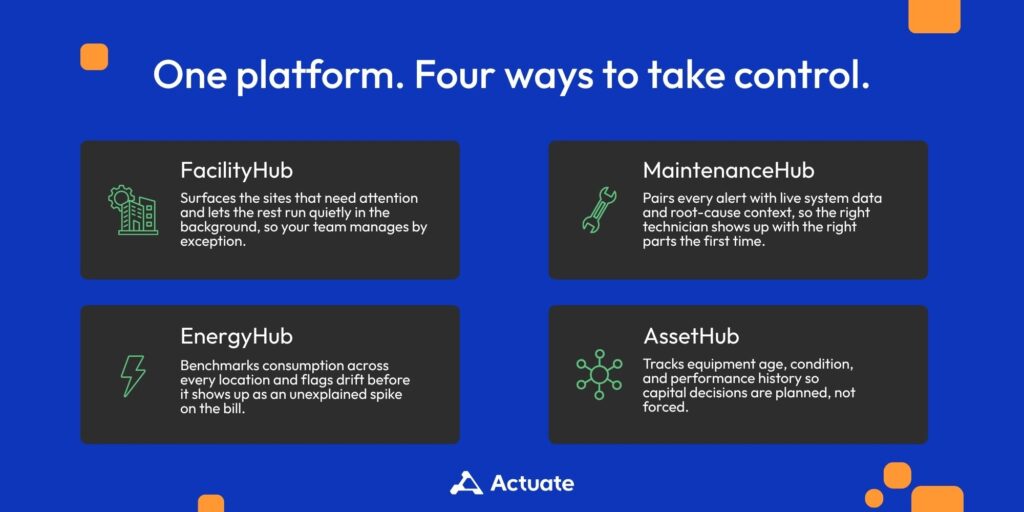
- The Action Layer. This is where decisions get made, not dashboards. FacilityHub ranks the portfolio by exception. MaintenanceHub sends work orders that carry live system data. EnergyHub turns the energy line into one an operator manages instead of absorbs. AssetHub puts real condition data behind every repair-or-replace call.
- The Operational Intelligence Layer, the Virtual Managers. FacilityMGR, MaintenanceMGR, EnergyMGR, and AssetMGR answer plain-language questions, summarize what’s happening, and point to the likely root cause before anyone is dispatched. They’re the facilities expertise a thin-margin portfolio could never afford to staff in every location. They make the team more capable, not bigger.
What the First Ninety Days Actually Feel Like
Not a feature list. The shifts a restaurant group notices once Act Hub is running:
- The weekend on-call goes quiet, because failures get caught days before they happen instead of during the Saturday rush.
- Vendor calls get short and specific. The team and the technician both know the fix before the truck arrives, so visits shrink and so do the invoices.
- Refrigeration stops being something anyone worries about. Walk-ins hold spec through any kitchen and any forecast.
- Maintenance follows the data instead of whoever shouted loudest, and spend becomes something a finance leader can actually forecast.
From Reactive to Strategic
Most restaurant operators are stuck in the same place on the maturity curve: reactive, running on phone calls and hope. A few have added preventive maintenance, calendars or a simple monitoring dashboard nobody reads, which moves the needle less than it should. The operators pulling ahead are the ones treating facilities the way they already treat labor and food cost, as a performance function they manage and optimize, not a bill they brace for.
The pricing lever is maxed out. Guests won’t absorb another price increase. The facility lever is finally available, and it doesn’t require a single new customer, a new campaign, or a new hire to pull. That’s what makes fixes before failures more than a maintenance philosophy. It’s a margin strategy.
Stop Running Restaurants on Hope
The equipment behind every dining room has never produced the data to manage it, so most restaurant groups have been running on hope: that the walk-in holds, that the RTU keeps up, that tonight isn’t the night something gives out. Act Hub replaces that hope with a portfolio-wide view of exactly what’s happening, before guests ever notice.
See what Actuate surfaces across your locations. Request a Demo