Spring isn’t really a season for restaurant portfolio operators. It’s a countdown.
The first genuinely warm weekend is when you find out which RTUs didn’t survive the winter unscathed, which walk-ins are taking too long to get back to setpoint after a delivery, and which locations are about to start calling in emergencies instead of serving customers.
If you run facilities for a multi-location operation, you already know this. You don’t find out your HVAC has a problem because someone caught it early. You find out because a guest complained, a store manager called it in, or a service ticket landed on your desk. By then, it’s already a disruption. You’re already behind.
And the costs stack up fast: emergency dispatches, after-hours premiums, lost revenue during peak hours when a dining room is 85 degrees and guests are walking out, and refrigeration failures that put food safety at risk. None of this is theoretical. It happens every spring across QSR and restaurant portfolios of every size.
What makes spring HVAC readiness especially difficult is how the pressure builds. April brings transitional weather that stresses systems in both directions — one day heating, the next cooling. May brings longer, hotter days. By June, the load doesn’t let up. Operators who haven’t prepared aren’t dealing with one bad weekend. They’re managing a compounding wave of HVAC and refrigeration failures that stretches deep into summer, well past the point when those systems need to be performing at their best.
So the question worth asking is this: what if you could identify which systems need attention before the season starts, without sending a technician to every location?
Why Scheduled PM Programs Fail Multi-Location Restaurant Operators
Every multi-location operator has a version of a spring readiness plan. Scheduled PM visits. Seasonal checklists. Maybe a vendor contract that sends technicians out in April to check boxes across the portfolio. It feels proactive. It isn’t.
The problem with blanket PM programs is that they treat every unit the same. A 2-year-old RTU at a low-traffic location gets the same visit as a 12-year-old unit running 18 hours a day in Phoenix. One of those units needs immediate attention. The other one doesn’t. But the program can’t tell the difference. That’s not a strategy. It’s a spreadsheet.
Seasonal checklists have the same blind spot. A technician checks a box on a Tuesday. The compressor starts short-cycling on Thursday. Nobody connects the two because there’s no continuous thread between a one-time visit and how the system is actually performing day to day. It’s a snapshot in a world that needs a movie.
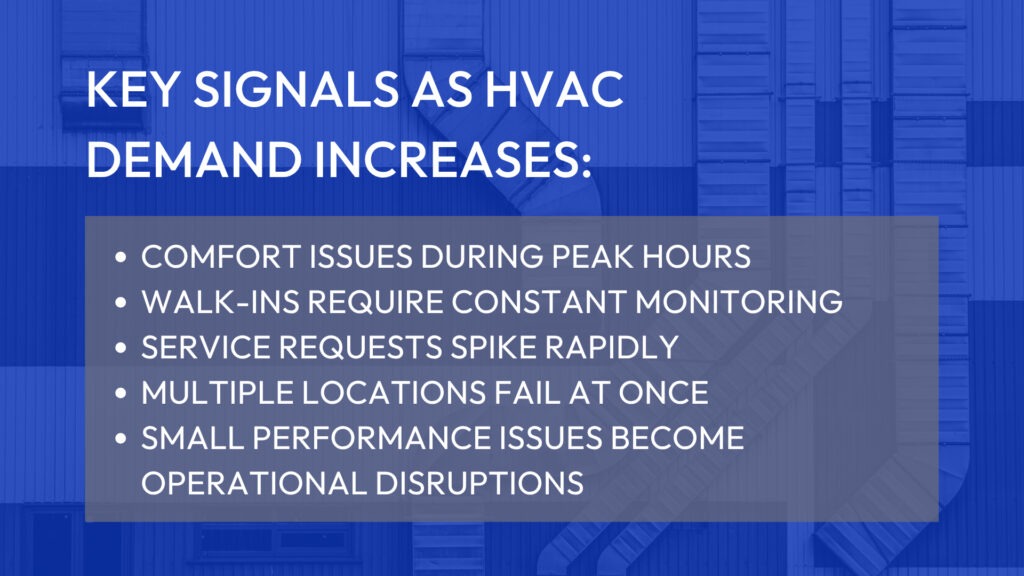
The result is predictable. Every spring, the same failures surface across the portfolio:
- RTUs that struggled through transitional weather go down during the first sustained heat
- Walk-ins that held temperature through winter start struggling to recover after deliveries
- Comfort complaints stack up during peak hours, right when dining rooms are fullest
- Emergency calls land simultaneously across multiple locations, and vendor schedules can’t absorb the volume
For operators with a dedicated facilities team, April through June becomes scramble mode instead of strategic operations. For the majority of QSR and restaurant groups under 50 locations who don’t have that dedicated team, the burden falls directly on operations — the same people already responsible for store performance, guest experience, and revenue.
The old playbook was built before continuous performance data was accessible at the portfolio level. Now it is.
How Predictive Facility Intelligence Changes Spring Preparation
There is a better way to go into spring. Not with more checklists. Not with more vendor visits. With intelligence that tells you what’s actually happening across your portfolio before the season forces the answer.
That’s what Act Hub was built to do. It’s a facility intelligence platform that gives operators continuous, portfolio-wide visibility into how their equipment is actually performing — not a snapshot from last Tuesday, but high-frequency data analyzed in real time that catches drift, surfaces patterns, and identifies the locations that need attention before they become the ones calling in emergencies.
- Portfolio benchmarking. Act Hub compares energy consumption, operational runtimes, thermal performance, and equipment KPIs across every location in the portfolio automatically. You can see which stores are running well and which ones are starting to slip — without digging through spreadsheets or waiting for an invoice to flag the problem.
- Performance scoring. Every location gets a thermal and comfort performance score that reflects how well HVAC and refrigeration systems are holding conditions. Instead of waiting for a guest complaint or a store manager’s call, you can sort your entire portfolio by the sites that need attention first.
- Functional testing. Act Hub can run systems through controlled tests and evaluate the response — staging compressors, checking cooling sequences, flagging units that won’t come on or can’t deliver capacity. You find out on your terms, not during a lunch rush.
- Performance drift tracking. Because systems degrade gradually, Act Hub tracks how each unit is performing compared to its own baseline. A unit that cooled well last September may already be showing signs of refrigerant loss, a failing contactor, or coil fouling. According to the U.S. Department of Energy, heating and cooling systems are among the largest energy uses in commercial buildings — and when performance declines, the impact shows up in both operating costs and reliability before anyone at the store level notices. Act Hub identifies which units have drifted before the season and puts them under full load.
That’s the difference between spring readiness as a guessing game and spring readiness as a strategic plan.
What Act Hub Does Across a Multi-Location Restaurant Portfolio
If all of this sounds too good to be true, it’s worth understanding what’s actually behind it. Act Hub isn’t a glorified thermostat. It’s not another monitoring dashboard you have to babysit. It’s a modular platform built around four Action Hubs that each handle a different piece of the operations puzzle. Together, they give you something most multi-location operators have never had: a complete picture of what’s happening across every location, with clear guidance on what to do about it.
- Facility Hub: The command center. Portfolio-level visibility with real-time performance scores, equipment KPIs, and management-by-exception views that surface what needs attention and let the rest run. You’re not scrolling through 80 locations looking for problems. The platform tells you where to look. That’s how spring readiness becomes manageable even for lean teams.
- Maintenance Hub: Predictive alerts and diagnostics in one place. When a system shows signs of weakness, Act Hub doesn’t just flag it. It provides root-cause context so the right technician shows up with the right parts and the right understanding of what’s happening. Fewer second trips. Fewer surprises. Faster repairs.
- Energy Hub: Your earliest warning system. Tracks how energy consumption is shifting across the portfolio using digital energy twins, continuous models of how each system should be performing. When a location’s energy signature changes since last cooling season, that’s a signal worth investigating. Energy drift is often the first sign something is going wrong, long before a comfort complaint or compressor failure makes it obvious.
- Asset Hub: Condition and capital visibility across every location. Tracks equipment age, performance history, and condition so you can see which units are nearing end-of-life, which have declining performance trends, and where capital dollars should be prioritized. It takes repair-versus-replace decisions from gut feel to a data-driven process.
Tying it all together are Virtual Managers, the intelligence layer embedded across the platform. They surface prioritized actions, reduce coordination load, and help your team make faster, more confident decisions. Natural-language summaries, drift insights, remote diagnostics, time-to-critical projections. All in one place, all working from the same data, all focused on getting your team to the right answer faster.
What Spring Looks Like With and Without Predictive Facility Intelligence
It’s easy to talk about predictive intelligence in the abstract. Here’s what it actually looks like on a Saturday in May.
Without Act Hub, the first 85-degree weekend hits, and three locations report no AC. Two walk-in coolers are running warm and struggling to hold temp. The facilities team, or more likely the ops team, is fielding emergency calls and dispatching after-hours techs. The technicians show up without context. They diagnose on the spot. Half of them need to come back with parts. That weekend costs five figures across the portfolio. And it repeats every weekend for the next six weeks.
With Act Hub, the story is different. Back in March, functional tests across the portfolio flagged seven units with performance issues: two compressors that wouldn’t stage properly, one unit showing symptoms consistent with refrigerant loss, and four locations with declining thermal scores compared to last year’s baseline. The team reviewed the prioritized list, scheduled repairs during the week when it was convenient, and entered summer knowing exactly where things stood.
The outcome on that first hot Saturday? Zero emergency calls. Technicians had already been out with the right context and the right parts. Repairs were planned, not reactive. Operations stayed uninterrupted. Guests never noticed a thing.
That’s the point. The best facilities operations are the ones nobody has to think about.
From Reactive to Strategic: How Multi-Location Operators Take Control of Facilities Performance
Spring readiness is where this story starts, but it’s not where it ends. The same intelligence that prevents a no-AC call in May also stabilizes energy spend in July, catches a walk-in drifting in August before it becomes a food safety event, and gives you real data to support capital planning for next year. This isn’t a seasonal tool. It’s a different way of running your operation.
Most operators today are managing by reaction. Something breaks, someone calls it in, you dispatch, you pay, you move on to the next one. That cycle burns money, burns out your team, and keeps you stuck in a mode where every day feels like you’re putting out fires. Act Hub breaks that cycle by surfacing what needs attention and letting the rest run. That’s management by exception, and it’s how lean teams scale without adding headcount or complexity.
This isn’t about replacing your team. Whether you have a dedicated facilities group or your operations leaders are carrying that load on top of everything else, Act Hub makes them more capable. It gives them confidence that the portfolio is covered, data to back up the decisions they’re already making, and time back because they’re not chasing alarms or sifting through noise to figure out what actually matters.
The operators who figure this out first have an edge. They protect revenue because their locations stay open and comfortable. They protect the guest experience because problems get solved before anyone notices. And they protect margins because maintenance spend becomes predictable instead of volatile. That edge is real, and the operators still waiting for the first hot day to find out what’s broken are leaving it on the table.
Take Control of Spring HVAC Readiness Before the Season Starts
Spring readiness isn’t a maintenance checklist. It’s an operational strategy. The question isn’t whether your systems will be tested this summer. They will. The question is whether you’ll know about the weak ones before your guests or your crews do.
If you’re heading into this season without visibility into how your equipment is actually performing across the portfolio, now is the time to change that. Act Hub was built to make predictive operations affordable and accessible for multi-location operators. Actuate works with restaurant groups to build a clear picture of portfolio readiness before the heat arrives.
Book a spring readiness conversation with the Actuate team. We’ll show you exactly what predictive operations look like for your portfolio.